Are Expensive Vitamin C Serums Really Worth It?
SkinCeuticals C E Ferulic is one of the best-known vitamin C serums in the world. Its signature formula combines pure vitamin C with vitamin E and ferulic acid.
A 30 mL (1 oz) bottle costs around $185 in the US. Even as a physician, I hesitate before buying it.
So, is it worth the price?
There’s good science behind its formula. Researchers at Duke University studied how to keep vitamin C stable and help it penetrate the skin. Their work helped establish the scientific foundation for C E Ferulic and its patented formulation technology.
But you don’t necessarily need to spend this much to get the benefits of vitamin C.
One of the key US patents behind the original formula expired in 2025. Today, more affordable serums offer similar ingredient combinations.
The challenge is knowing how to choose a good one.
This is the first post in my new series, Skincare Ingredients, Explained.
A 2025 study published in the Journal of the American Academy of Dermatology asked cosmetic dermatologists which ingredients they recommend for common skin concerns. Vitamin C was among them, along with retinoids, niacinamide, and several others.
Inspired by this study, I’ll explore some of these ingredients, drawing on medical evidence and my clinical experience in Seoul to make skincare science easy to understand and practical for your daily routine.
Let’s begin with vitamin C.
What Does Vitamin C Do for Your Skin?
Vitamin C has three important roles in skin health.
First, it’s a powerful antioxidant.
When UV radiation reaches your skin, it generates reactive oxygen species, often called free radicals. These unstable molecules can damage proteins, lipids, and DNA, contributing to premature skin aging.
Vitamin C helps neutralize these free radicals.
Think of sunscreen as your first line of defense against UV exposure. Vitamin C provides additional antioxidant protection against some of the oxidative stress that follows.
Second, vitamin C supports collagen production.
Collagen gives skin much of its structure and strength. Vitamin C is essential for normal collagen synthesis, and several clinical studies suggest that topical vitamin C can improve fine lines and other signs of photoaging.
Third, it can help reduce unwanted pigmentation.
Vitamin C interferes with melanin production, making it a useful ingredient for improving uneven skin tone and certain types of dark spots.
These benefits are supported by biological research and human studies, although the clinical evidence is less extensive than the marketing might suggest. A 2023 systematic review identified just seven randomized clinical trials involving 139 participants.
There’s also a more practical challenge.
Even the most promising ingredient won’t do much if it cannot reach the skin layers where it needs to work.
And that’s where vitamin C gets complicated.
Why Is Pure Vitamin C So Difficult to Formulate?
Look at the ingredient list of a vitamin C serum, and you may find the name Ascorbic Acid.
This is pure vitamin C, also known as L-ascorbic acid (LAA), one of the most extensively studied forms of topical vitamin C.
But it comes with two major challenges.
The first is instability.
Pure vitamin C, especially in water-based solutions, is vulnerable to oxidation. Exposure to oxygen, light, and heat can gradually break it down and reduce the amount of active vitamin C available.
The second is poor skin penetration.
Your skin’s outermost layer, the stratum corneum, acts as a protective barrier. Because this barrier is rich in lipids, water-soluble substances such as vitamin C have difficulty passing through it.
This explains why developing an effective vitamin C serum involves much more than adding vitamin C powder to a bottle.
Let’s look at what really matters when choosing one.
How to Choose a Vitamin C Serum
1. Concentration: Is Higher Always Better?
In a landmark study published in 2001, Pinnell and his colleagues investigated how the concentration of L-ascorbic acid affected skin absorption.
Using primarily pig skin, they found that increasing the concentration improved vitamin C delivery up to approximately 20%. Beyond that point, higher concentrations did not increase the amount entering the skin.
This research helped establish the popularity of vitamin C serums containing around 10–20% L-ascorbic acid.
But there’s an important distinction: more vitamin C entering the skin doesn’t automatically mean better clinical results.
Human studies have shown improvements in photoaged skin with concentrations as low as 5%.
Higher concentrations may also increase irritation. If you’re new to vitamin C, starting with a lower concentration is often a sensible choice.
2. pH: Why Does Acidity Matter?
Another key factor is pH, which measures how acidic or alkaline a solution is.
In water, L-ascorbic acid changes its electrical charge depending on the pH.
At a lower pH, more vitamin C exists in an uncharged form, making it easier to pass through the skin’s lipid-rich barrier.
Pinnell’s study found that L-ascorbic acid penetrated the skin effectively when formulated below pH 3.5.
This is why many water-based vitamin C serums are considerably more acidic than the skin’s natural surface.
The trade-off is irritation.
Low-pH formulas can cause stinging or burning, particularly in people with sensitive or compromised skin barriers.
In my clinic in Seoul, I often remind patients that irritation is not proof that a product is working. You shouldn’t have to tolerate persistent redness or burning to get the benefits of vitamin C.
3. Pure Vitamin C or Vitamin C Derivatives?
Among the different forms of vitamin C, pure L-ascorbic acid is the most extensively studied. However, its instability and potential for irritation have led to the development of vitamin C derivatives.
You may see ingredients such as:
- Ascorbyl Glucoside
- Sodium Ascorbyl Phosphate (SAP)
- Magnesium Ascorbyl Phosphate (MAP)
- 3-O-Ethyl Ascorbic Acid
- Ascorbyl Tetraisopalmitate (or Tetrahexyldecyl(THD) Ascorbate)
These are chemically modified forms of vitamin C.
Some are more stable than pure L-ascorbic acid, while others can be formulated at a less acidic pH, potentially making them easier to tolerate.
Their biological activity and skin delivery vary, and clinical evidence is more limited for many derivatives.
That doesn’t necessarily make them inferior. For someone who finds pure vitamin C too irritating, a well-formulated derivative may be a more practical choice.
4. What About Water-Free Vitamin C?
Not every vitamin C product is a traditional water-based serum.
Some manufacturers use water-free, or anhydrous, formulations to address vitamin C’s stability problem.
These products may dissolve vitamin C in non-water solvents or suspend fine vitamin C particles in silicone-based formulas.
Reducing water exposure can improve stability, but water-free doesn’t automatically mean gentler. Vitamin C can still cause irritation when it comes into contact with moisture on the skin.
Some water-free products also feel oily, sticky, or slightly grainy.
They’re another option worth considering, depending on your skin’s tolerance and your preferred texture.
How to Use Vitamin C Serum Effectively
Choosing the right serum is only half the story. How you use and store it also matters.
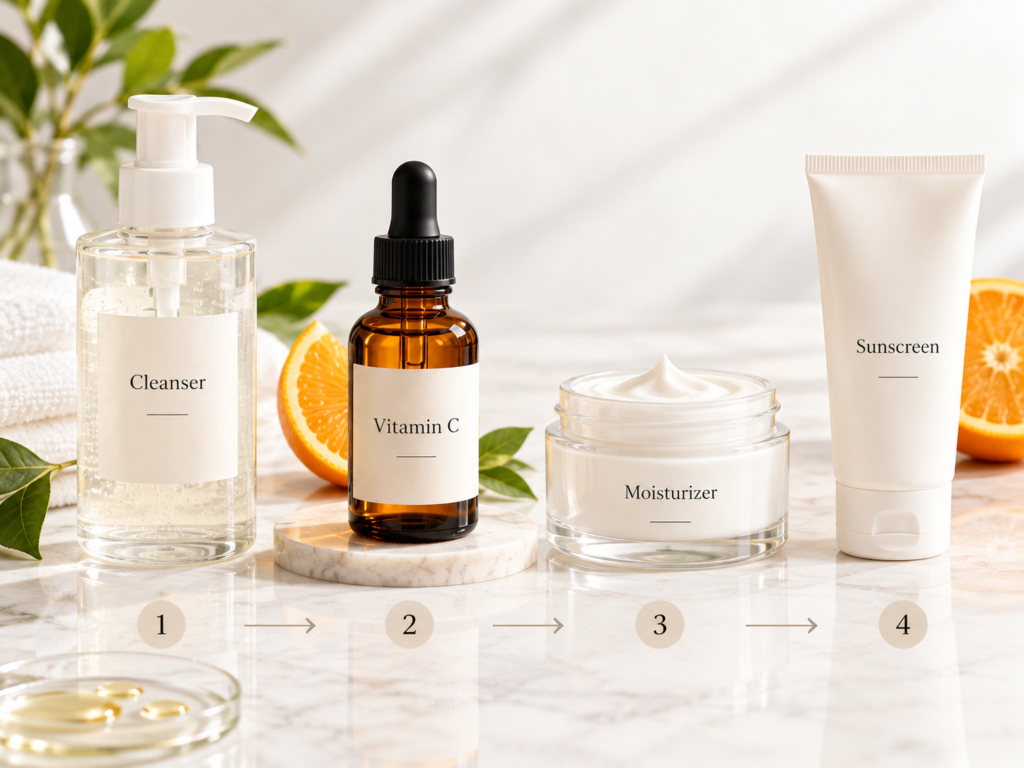
Apply It Before Your Moisturizer
For a typical water-based L-ascorbic acid serum, I recommend applying it to clean, dry skin before your moisturizer.
Let the serum settle, then follow with your usual moisturizer.
You don’t need to wait exactly five or ten minutes. There’s no convincing clinical evidence that a specific waiting period improves vitamin C absorption.
Likewise, warming the serum in your palms or repeatedly patting it into the skin isn’t necessary.
A good formulation does the important work.
Morning or Night?
Both are fine, although I generally prefer morning application.
Because vitamin C provides antioxidant protection against UV-induced oxidative stress, it makes a useful addition to your morning routine.
Apply sunscreen afterward. Vitamin C complements sunscreen; it doesn’t replace it.
If you already use a retinoid at night, consider keeping vitamin C in your morning routine.
There’s no rule that the two ingredients cannot be used together. Separating them simply makes it easier to manage irritation.
Storage Matters More Than You Think
Pure vitamin C is sensitive to heat, light, and oxygen.
Keep the bottle tightly closed and away from direct sunlight and excessive heat.
You may notice that some vitamin C serums gradually turn yellow or amber after opening.
This can be associated with oxidation, but color alone cannot tell you exactly how much active vitamin C remains. Some properly formulated products naturally develop a darker color while retaining acceptable stability.
You also don’t need to rush to finish every vitamin C serum within just one or two months. Follow the manufacturer’s recommended period after opening.
Still, vitamin C is not an ingredient I would buy in large quantities and leave sitting on a shelf for months.
Which brings us back to the question of price.
So, Are Expensive Vitamin C Serums Worth It?
SkinCeuticals C E Ferulic earned its reputation through meaningful research into vitamin C stability, skin delivery, and antioxidant protection.
That science has value.
But a well-researched formula doesn’t necessarily mean a more expensive product will produce better results for everyone.
Nor should a lower price automatically make us question a product’s effectiveness.
When choosing a vitamin C serum, I would focus on three things:
- The form and concentration of vitamin C. What active ingredient are you actually getting?
- The formulation. Has the product been designed with stability and skin delivery in mind?
- Your skin and your budget. Can you use it comfortably and consistently?
Vitamin C isn’t an overnight treatment. Improvements in pigmentation, fine lines, and skin texture may take weeks or months of regular use.
And because vitamin C can gradually degrade, a reasonably priced, well-formulated serum that you use consistently may be a better long-term investment than an expensive bottle you try to make last forever.
The science behind vitamin C is promising, but human clinical studies remain relatively limited.
When you understand how vitamin C works and what keeps it stable, you don’t need to rely on a famous brand name or a high price tag. Ultimately, good skincare comes down to choosing a formula your skin can use comfortably and consistently.
I hope this helps you make more confident decisions about your skincare.
References
- Pinnell SR, et al. (2001). Topical L-ascorbic acid: Percutaneous absorption studies. Dermatologic Surgery, 27(2), 137–142.
- Lin FH, et al. (2005). Ferulic acid stabilizes a solution of vitamins C and E and doubles its photoprotection of skin. Journal of Investigative Dermatology, 125(4), 826–832.
- Correia G, Magina S. (2023). Efficacy of topical vitamin C in melasma and photoaging: A systematic review. Journal of Cosmetic Dermatology, 22(7), 1938–1945.
- SkinCeuticals — C E Ferulic official product information.
Leave a Reply